


Larch Shelterbelts for UK Small Woods: Spacing, Layout and Wind Protection
A good larch shelterbelt changes how a small wood behaves. It takes the sting out of wind that rocks young broadleaves, dries out newly planted ground and makes winter work miserable. Larch gets there faster than most broadleaves, and it stays light enough to let other things grow beneath it. Get the spacing and layout right, though, or you will spend a decade looking at rows of trees that shelter almost nothing.
What larch does well, and where it stops
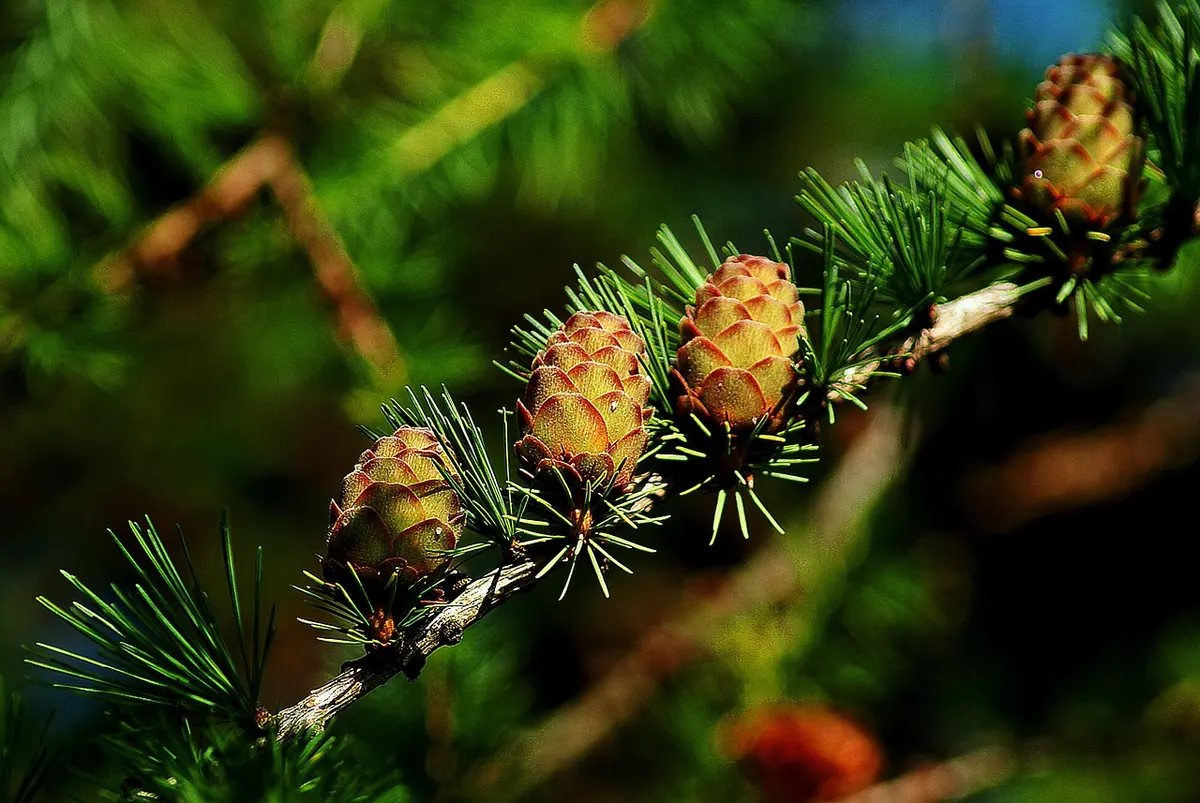
Larch is a conifer that behaves like a broadleaf. Its needles turn gold and drop each autumn, so a belt never becomes a black wall and the ground beneath stays workable. On a reasonable site, hybrid larch will often add 60 cm or more of height a year once established, which is what makes it such a useful quick-start shelterbelt around new planting. That light shade is a genuine advantage: unlike denser conifers, it leaves room for woodland flowers and natural regeneration to come through, so the belt can double as a productive edge rather than a dead strip.
Be clear about the trade-off. From November to April larch is bare. Trunks and branches still blunt wind, but they give nothing like the winter protection of Scots pine or Norway spruce. Where livestock, polytunnels or late brassicas need shelter in January, plan a mixed belt rather than a pure one.
Choosing which larch to plant
Three sorts are widely sold in the UK: European larch, Japanese larch and hybrid larch, sometimes listed as Dunkeld larch. Hybrid larch combines Japanese vigour with European form and is usually the safest bet for shelter work. Japanese larch suits mild, wet western sites; European larch copes better with cold, exposed eastern ones.
Buy two-year-old bare-root transplants, roughly 40–60 cm tall. Smaller stock settles faster than big, leggy plants and costs less to replace. Cell-grown trees are fine too, but plant them in early autumn while the soil is still warm.
Read the site before you plant a single tree
Walk the boundary in a gale if you can. Note where the wind actually hits, not where the map says it should. South-westerlies dominate across most of the UK, but valleys funnel wind along their length, and an existing hedge will tell you more than any compass point.
Then work out what you are protecting. A porous belt gives useful shelter to roughly ten times its height downwind, with the best protection at five to ten times the height. A belt that reaches 15 m therefore does real work over 75–150 m. That figure usually decides where the belt sits: far enough upwind to cover the field, close enough not to waste ground.
Soil matters just as much. Larch likes deep, moist but free-draining ground, slightly acid to neutral, and sulks on shallow chalk or heavy clay that stays wet all winter. On those sites, plant Scots pine, birch or a thorn-heavy mix and accept a slower result. Avoid ridgetops and thin soils over rock, where larch can rock loose in a storm. Leave a few metres between the belt and any ditch or boundary so you have room to work, and check field drains, buried services and grant conditions before you order.
Spacing, rows and layout
Shelterbelts work through porosity, not solidity. A dense, airtight wall pushes wind up and over, then drops it in a destructive eddy a short distance downwind. Aim for a belt that filters the wind, letting roughly 40–50% of it pass through the branches.
- Rows: three is the practical minimum; five is better where you have space. A single row is a hedge, not a belt.
- Within the row: 1.8–2.5 m apart. Tighter spacing closes the canopy sooner but produces weaker individual stems.
- Between rows: 2.5–3 m, wide enough for air to move and for you to get in with a brushcutter or thinning saw.
- Stagger the rows so trees sit opposite the gaps in the neighbouring row.
- Add a shrub edge of hawthorn, blackthorn or hazel on the windward side to fill the draughty gap at ground level.
- Run the rows across the prevailing wind. On an exposed western slope that often means planting up and down the field rather than along it.
Three rows at 3 m spacing gives a belt roughly 7–9 m deep, which is enough to filter wind rather than deflect it. Short on space? Two rows of larch behind a mixed shrub edge is a fair compromise, and far better than one lonely line of trees.
Planting and the first two seasons
Plant between November and March while the trees are dormant. Avoid frozen or waterlogged ground, and on dry eastern sites aim for autumn rather than late spring.
Weed control decides whether a shelterbelt succeeds. Clear a square metre around each tree with a mulch mat or careful spot treatment, and keep it clear for two or three growing seasons. Grass and nettles will outcompete young larch without any trouble.
Guard against rabbits and deer with fencing or tree guards suited to the pressure on your land, and check stakes and ties each spring. Beat up failures after the first winter; losing around one tree in ten is normal, and filling the gaps early keeps the belt’s porosity even.
Thinning, disease and the long game
Once the canopy closes, thin rather than let the belt stagnate. Remove the worst-formed and suppressed trees, favouring good stems on the windward edge so the belt keeps its structure. Early thinnings give you firewood and fence posts.
Larch across the UK is affected by Phytophthora ramorum, which causes crown dieback and resin-bleeding cankers on the stems. Watch for sparse, yellowing crowns in summer and dark, weeping patches on the bark. Report suspected cases through TreeAlert or to the relevant forestry authority rather than felling on a hunch. Guidance discourages large pure blocks of larch in higher-risk areas, and some grant schemes will not fund them, so check the rules for your part of the UK before you commit.
Restock gaps with a mix of species rather than more larch. A belt with two or three conifer species and a thorny understorey is far more resilient than one depending on a single tree.
Practical starting points
Measure the field, work out the height your belt will realistically reach, and site it so the shelter lands where you need it. Order two-year-old transplants of hybrid or Japanese larch, plan three to five staggered rows with a shrub edge, and budget as much for weed control and guards as you do for the trees.
Then plant, keep the ground clear and wait three seasons. After that a larch shelterbelt largely looks after itself, and earns its keep for decades.
Photo: uroburos / Pixabay